
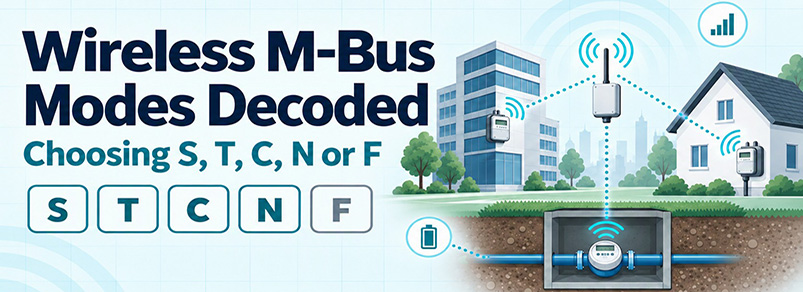
Wireless M-Bus is defined by EN 13757-4 and supports 5 distinct operating modes, each with its own frequency band support, modulation, data rate, and duty cycle. Choosing the wrong mode for your application will not necessarily break the communication, but it will cost you battery life, range, or compatibility with the existing network already deployed in the field.
This guide goes through the specification and gives you advice on how to make the optimal decision for S, T, C, N, and F modes, along with the data rates and practical range figures you need to make this decision.

The Key Variables That Wireless M-Bus Modes Trade Off Against Each Other
Before going mode by mode, it helps to understand what the EN 13757-4 specification is actually optimising:
- Duty cycle: How often the meter transmits. A high duty cycle (T-mode: every few seconds) gives near-real-time data but drains the battery quickly. A low duty cycle (S-mode: a few times per day) extends battery life to 15–20 years but limits how often you see fresh data.
- Data rate: Higher data rate means a shorter transmission burst, which means less time on air per data packet and less chance of interference. However, higher data rates are generally less sensitive, which reduces range.
- Frequency and propagation: 868 MHz penetrates buildings well and is the dominant choice in Europe for S, T, and C modes. 169 MHz (N-mode) has even better object penetration properties including optimal operation in a dense urban environment and underground installations due to its longer wavelength.
- Uni- vs. bi-directional: Unidirectional modes send data upward from the meter to the gateway only. Bi-directional modes allow the gateway to send control or configuration commands down to the meters as well, enabling features like meter configuration upgrades through over-the-air updates.
Wireless M-Bus Modes: S-mode (Stationary)
Frequency: 868.3 MHz (or 433 MHz in markets where 868 MHz is restricted)
Data rate: 32.7 kbps, Manchester coded
Transmission interval: A few times per day, configurable
Direction: S1/S1-m unidirectional; S2 bi-directional
Primary use: Stationary meters with long battery life requirements, walk-by or drive-by AMR collection
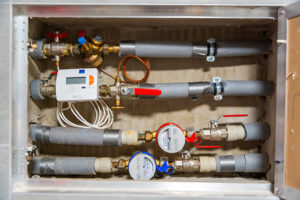
S-mode is the battery-life choice. A meter in S1 mode that transmits twice per day can sustain 15–20 years of battery life. The 32.7 kbps rate with Manchester coding works optimally with devices in motion, which is why the S1-m variant specifically targets mobile receivers (vehicles, handheld collectors moving past the meter).
Choose S-mode when: Battery life is the primary design constraint and you only plan to send data a couple of times a day. Typical applications are residential gas, water, electricity, and heat meters where consumption is read a couple of times monthly or daily for billing purposes.
Watch out for: S-mode provides no acknowledgments when sending unidirectional data, so a transmission sent when interference is present is simply lost. If your utility requires confirmed delivery, use S2 or consider T or C-mode.
Wireless M-Bus Modes: T-mode (Frequent transmit)
Frequency: 868.95 MHz transmit; 868.3 MHz gateway receive (T2: also 868.3 MHz uplink)
Data rate: 100 kbps device transmit (3-out-of-6 coding); 32.7 kbps gateway transmit
Transmission interval: Every few seconds, configurable
Direction: T1 unidirectional; T2 bi-directional
Primary use: Fixed AMR network with near-real-time data availability, sub-metering
T-mode is designed for fixed network infrastructure where meters transmit frequently and a permanent gateway or concentrator in the building aggregates readings. The short air time of each data packet reduces collision probability with other data packets in the spectrum even when many meters transmit at similar intervals.
Choose T-mode when: You need data on a sub-minute basis for energy management, leak detection, or polling sub-meters. T-mode is common in district heating networks and commercial building sub-metering where a building concentrator collects data from 20–200 meters every few seconds.
Watch out for: The frequent transmission cycle means significantly higher average current draw. T-mode meters typically require a larger primary battery or mains assistance to achieve a reasonable operating life. Battery-powered T-mode meters transmitting every 15–30 seconds can expect 5–8 years on a large primary battery depending on payload size.
Wireless M-Bus Modes: C-mode (Compact)
Frequency: 868.95 MHz (C1/T1); 869.525 MHz gateway transmit (C2)
Data rate: 100 kbps device transmit, NRZ coded; 50 kbps gateway
Transmission interval: Stationary (not continuously transmitting like T-mode)
Direction: C1 unidirectional; C2 bi-directional
Primary use: High-throughput metering, smart meter gateways, gateway-to-meter downlink transmissions
C-mode uses NRZ coding rather than the 3-out-of-6 coding of T-mode. This raises the effective data rate on the uplink transmissions to 100 kbps and the downlink to 50 kbps, making it the highest-throughput mode in the 868 MHz band. A C1 gateway can also receive T1 device transmissions, so C2 infrastructure is backward compatible with T1 meters already in the field.
Choose C-mode when: You need the highest data throughput at 868 MHz, for example when meters carry extended payloads with multiple data records, or when a smart meter gateway needs to serve as a fast repeater for downstream devices. C-mode is also preferred when the gateway side needs to send long configuration payloads downlink.
Watch out for: NRZ coding provides no inherent redundancy. The link margin, also known as, the robustness of the communication link between two devices, must be sufficient for reliable operation; C-mode is not recommended for deep-penetration or long-range communication links where S or N-mode would be more appropriate.
Wireless M-Bus Modes: N-mode (Narrowband, 169 MHz)
Frequency: 169 MHz, 12.5 kHz or 50 kHz channel spacing
Data rate: 4.8 kbps (N1a-f), 19.2 kbps (N1g/N2g)
Direction: N1 unidirectional; N2 bi-directional
Primary use: Hard-to-reach meters, underground installations, wide-area utility networks
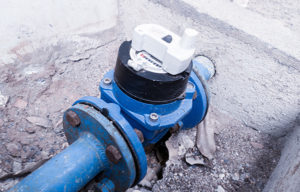
N-mode operates at 169 MHz. The long wavelength allows for great penetration of objects, long range, and long battery life. For example, the 169 MHz band can more readily penetrate soil, concrete, and building materials with significantly lower data loss than higher frequencies. A meter installed in a sealed pit below ground level, in a steel enclosure, or in a dense urban basement, would suffer significant data loss at 868 MHz compared to the 169 MHz band.
Radiocrafts’ N-mode products (RC17xx-MBUS4 family) support 27 dBm or 30 dBm transmit power, further extending coverage. A single gateway can cover several kilometres in urban environments, making N-mode cost-effective for wide-area utility rollouts where deploying dense gateway infrastructure is impractical.
Choose N-mode when: Meters are in underground or heavily shielded locations where 868 MHz fails, or when a wide-area coverage with minimal infrastructure is a design requirement. N-mode is the standard choice for gas distribution networks in France and is gaining adoption in water utility networks where meter pits are the norm.
Watch out for: Lower data rate means longer air time per telegram, which has two consequences. First, the duty cycle rules for 169 MHz are more restrictive than 868 MHz in some regulatory frameworks; verify compliance with ETSI EN 300 220. Second, payload size per data packet is limited by the need to keep air time within duty cycle limits.
Wireless M-Bus Modes: F-mode
F-mode is defined in the EN 13757 standard but is rarely implemented or deployed in current products. It was intended as a combined mode compatible with both S and T modes, but the lack of commercial adoption means it is not a practical choice for new designs. Radiocrafts modules do not implement F-mode.
Mode selection summary
Mode |
Frequency Band |
Data Rate / Coding |
Uni- / Bi-Directional Communication |
Transmission Frequency |
Description of Use |
Key Decision Factor |
|---|---|---|---|---|---|---|
S1 |
868.3 MHz; 433 MHz where 868 MHz is restricted |
32.7 kbps, Manchester Coding |
Uni-Directional |
A few times per day, configurable |
Stationary gas, water, electricity, and heat meters sending infrequent readings for battery life. |
Choose when maximum battery life is the priority and only occasional readings are required. |
S1-m |
868.3 MHz; 433 MHz where 868 MHz is restricted |
32.7 kbps, Manchester Coding |
Uni-Directional |
A few times per day, configurable |
Stationary meters read by mobile receivers, including walk-by, drive-by, handheld, or vehicle-mounted gateways. |
Choose for walk-by or drive-by AMR systems where the receiver moves past the meter. |
S2 |
868.3 MHz; 433 MHz where 868 MHz is restricted |
32.7 kbps, Manchester Coding |
Bi-Directional |
Infrequent, configurable |
Stationary meters that need long battery life together with gateway-to-meter communication. |
Choose when S-mode battery lifetimes and two-way communication are both required. |
T1 |
868.95 MHz |
100 kbps, 3-out-of-6 coded |
Uni-Directional |
Every few seconds, configurable |
Frequent meter transmissions to a fixed gateway or concentrator in AMR systems and commercial sub-metering networks. |
Choose for frequent, near-real-time uplink meter readings. |
T2 |
868.95 MHz uplink; 868.3 MHz gateway transmission / uplink support |
100 kbps device transmissions; 32.7 kbps gateway transmissions |
Bi-Directional |
Every few seconds, configurable |
Fixed networks requiring frequent readings plus acknowledgements, configurations, or commands from the gateway. |
Choose for frequent data transmissions combined with bi-directional communication. |
C1 |
868.95 MHz |
100 kbps, NRZ coded |
Uni-Directional |
Application-dependent; Stationary |
High-throughput uplink communication for meters carrying larger or multiple data records. C1 gateways can also receive T1 transmissions. |
Choose when high uplink data throughput is the priority and downlink communication is not required. |
C2 |
868.95 MHz uplink; 869.525 MHz downlink |
100 kbps device transmission; 50 kbps gateway transmissions, NRZ coded |
Bi-Directional |
Application-dependent; Stationary |
high-throughput bi-directional metering, smart meter gateways, repeaters, larger payloads, and long configuration messages. |
Choose when both high data throughput and bi-directional communication are required. |
N1 |
169 MHz; 12.5 kHz or 50 kHz channel spacing |
4.8 kbps (N1a-f); 19.2 kbps (N1g) |
Uni-Directional |
Application-dependent |
Hard-to-reach meters in pits, basements, underground, or shielded locations, and wide-area utility networks. |
Choose for maximum range and penetration when meters only send uplink data. |
N2 |
169 MHz; 12.5 kHz or 50 kHz channel spacing |
Up to 19.2 kbps, depending on variant |
Bi-Directional |
Application-dependent |
Hard-to-reach meters that need gateway-to-meter communication while retaining 169 MHz range and penetration. |
Choose for difficult installations requiring both coverage and bi-directional communication. |
F |
Defined by EN 13757 |
Combined S/T-compatible concept; Implementation-dependent |
Implementation-dependent |
Not commonly deployed |
Legacy standards-reference mode intended for compatibility with S and T modes, but with little commercial adoption. |
Generally not recommended for new designs. |
Security applies across all modes
Regardless of which mode you choose, EN 13757-7 defines AES-128 based encryption and authentication for the application layer. OMS (Open Metering System) specifies how keys are provisioned and rotated. Any field deployment should provide encryption keys before the meters leave the factory or before installers leave the site. Unencrypted data packets are visible to any receiver tuned to the same frequency and mode, which is a significant data privacy risk for a billing system.
Radiocrafts modules support AES-128 encryption across all modes. Read the Radiocrafts security white paper for more information on encryption for Radiocrafts modules.
Radiocrafts Wireless M-Bus module families
- RC11xx-MBUS3: 433/865/868/915 MHz, 10 dBm and 27 dBm variants, covers S, T, and C modes
- RC17xx-MBUS4: 169 MHz, 27 dBm variant, N-mode
- RC1xxx-MPC: Integrated pulse counter, for direct connection to pulse-output meters
- RC1xxx-MSM: Sensor interface modules for direct integration of temperature, pressure, and other sensor types
Explore Radiocrafts products and find out how we can support you with your next smart metering project!