

mioty is an LPWAN technology built to deliver reliable, scalable low-power wireless connectivity for large-scale industrial and commercial IoT deployments. It enables millions of devices to connect seamlessly, setting a new standard for massive global IoT performance.
Telegram Splitting (patented technology)

Best-in-class robustness vs noise

Best-in-class scalability for high density networks

Long Range, 20 km LoS

Compliant to ETSI TS 103 357 (specification for development of massive industrial IoT)

Bi-directional communication

Low-power for battery operation

Private Gateway
How it works
mioty delivers industry-leading reliability and scalability for massive IoT deployments with millions of connected devices.
This is made possible by Telegram Splitting, a patented technology standardized under ETSI TS 103 357 for large-scale industrial IoT networks.
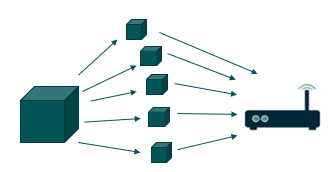
Telegram Splitting divides each message into small sub-packets, which are then transmitted independently across different frequencies and time slots. At the gateway, an algorithm continuously scans the spectrum and reconstructs the full message from the received sub-packets. Thanks to built-in redundancy, up to 50% of sub-packets can be lost without affecting the information content of the transmitted data.
As a result, mioty enables highly robust, energy-efficient wireless communication over long distances in demanding industrial IoT environments.
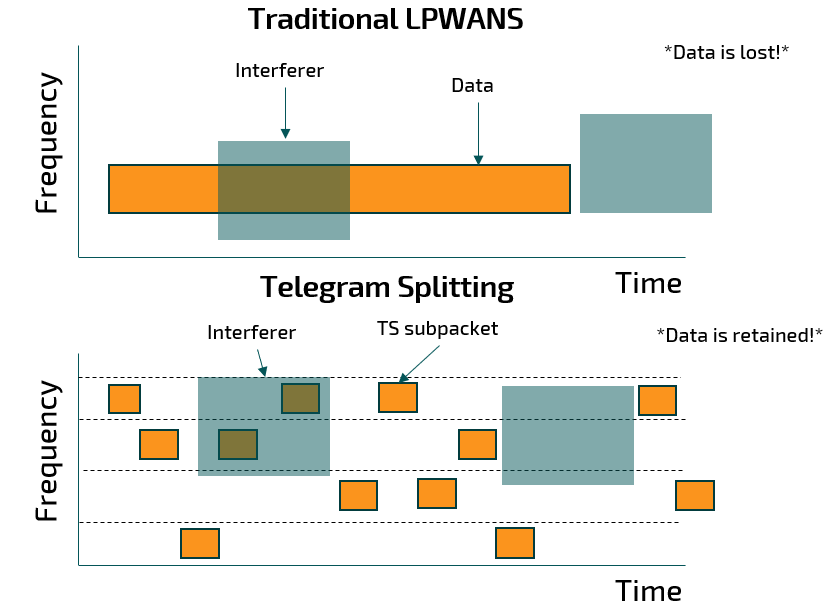
Wireless technologies operating in the license-free frequency bands are more prone to interference due to shared and crowded band use. As device density increases, spectrum congestion grows, leading to higher interference and potential data loss.
Telegram Splitting addresses this challenge by ensuring message reconstruction even when up to 50% of sub-packets are lost. This enables reliable communication including in environments where other wireless technologies struggle with interference and signal disruption. For example, mioty can hold a consistent stable performance in underground and hard-to-reach installations.
In addition, high reliability enables massive scalability, supporting networks with over one million devices and millions of daily transmissions.
mioty also supports long-range, bi-directional communication, and ultra-low power consumption for extended device lifetime. This allows reliable coverage across buildings, campuses, factories, and remote industrial or mining environments.
The network can be deployed in previously unreachable or crowded environments where traditional LPWAN solutions fail.
mioty module benefits and features include:
- Compliant to ETSI TS 103 357 supporting Telegram Splitting (patented technology)
- Best-in-class robustness versus noise for ultra-high reliability
- Best-in-class scalability for large-scale and dense networks (many nodes in close proximity)
- Long range of up to 20 km Line-of-Sight
- Bi-directional communication for efficient data communication for both sensor data collection and sensor control from the gateway
- Low power for battery operation
- Private gateway (no subscription costs like with cellular solutions)
- Massive IoT deployments – Have up to 1 million sensors sending 1.5 million messages per day
- Ultra-narrowband, high-performance radio for reliable long range
- High blocking properties to prevent packet losses from interference and noise
- mioty module is pin compatible with other products from Radiocrafts
- 2.3 – 3.8 V supply voltage
- Conforms with EU RED directive (EN 300 220, EN 301 489, EN 62368)
- Supports modes EU0, EU1, EU2, and US0 for bidirectional communication
- Small size (12.7 x 25.4 x 3.7 mm), shielded and optimized for SMD mounting
- No external components
mioty FAQ
What are the main benefits of a mioty network?
There are 4 major benefits that come from using a mioty network, and these include:
- Unmatched reliability and robustness compared to all LPWANs in the market today
- Ultra-scalable supporting up to 1.5 million data transmissions per day from 1 million + devices
- Long range – 20 kilometres Line-of-Sight
- Long battery lifetime to support long lasting installations (15 – 20 years)
What is the Telegram Splitting feature in mioty and how does it work?
Telegram Splitting is the core of a mioty network. It is a patented technology standardized under ETSI TS 103 357 for massive industrial IoT networks.
Telegram Splitting works by dividing a data packet into small sub-packets, which are then transmitted independently across different frequencies and time slots. An algorithm on the gateway side continuously scans the radio spectrum for sub-packets. Once the gateway collects all the sub-packets, it reconstructs the full data packet again.
Thanks to built-in redundancy, up to 50% of sub-packets can be lost without affecting the information content of the transmitted data packet.
This functionality is what makes mioty such a robust, reliable, and scalable solution.
Which applications are most suitable for mioty?
mioty works best for applications that require:
- Mostly uplink communication (ex: Sensor data collection)
- A large number of devices sending data frequently / High density of devices in close proximity to one another
- Quality of Service (High robustness and maximum successful packet delivery rates are important)
- Long project lifetimes (15 – 20 years)
- Battery-operated devices
mioty does not work so well for applications that require:
- Intensive control, aka, a lot of downlink communication from the gateway down to the sensors because the more control that is required in the network, the less scalable the network becomes. In addition, when sending frequent control commands from the gateway down to the sensors, this prevents the gateway from listening and receiving data packets from the sensors.
- Latency lower than 6 seconds. The Telegram Splitting process where a data packet is split into 24 sub-packets, then transmitted at different time slots and frequencies, and then reconstructed into a full message again creates some latency. So if you need instant responses to messages, mioty is not ideal.
- Sensor readings more frequently than every 30 seconds (in Europe). In Europe, there is a duty cycle limitation, which means, that the gateway for a single network can only send data up to 1% of the time. Anything beyond 1% is a violation of the duty cycle regulation in Europe. Therefore, having thousands of devices sending data every 30 seconds would certainly surpass this 1% limitation.
That being said, common applications which fit the above mentioned requirements include:
- Smart Metering (electricity, gas, water and heat metering)
- Smart City
- Smart Factory / Industry 4.0
- Building Automation
- Mobility (moving objects)
- Healthcare
How big is the mioty ecosystem?
The mioty technology was announced by the mioty alliance in February 2020, so it is still a young technology that is growing.
The mioty alliance has a vast ecosystem of 70+ members ranging from:
- End point sensor manufacturers
- Radio module and other communication device providers (like Radiocrafts)
- Base station (gateway) manufacturers
- Service centers responsible for routing the data between end-point applications and the application center via the service center application center Interface (SCACI).
- Application centers responsible for interfacing applications to the mioty network via various available interface protocols (such as MQTT, Rest, COAP).
- IoT Platform providers which typically consist of a database and tools for visualization and analyzing the application data.
What is the Radiocraft offering for mioty?
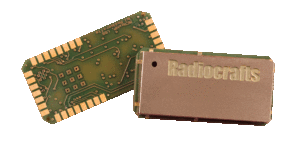
Radiocrafts offers an RF module with embedded mioty protocol, the RC1882CEF-MIOTY1 module.
The RC1882CEF-MIOTY1 is a compact surface-mounted, high performance radio module that is pre-certified for operation under European (868 MHz) and US (915 MHz) regulations. It supports a UART interface and is based on an AT command sets. The module is shielded and measures only 12.7 x 25.4 x 3.7 mm, pin compatible with legacy modules for easy integration.
For high volume customer, we also offer customisation of the RF module for turn-key solutions or specific project requirements.
We also offer the RC1882-MIOTY1-DK Development Kit for testing and evaluation purposes.
Order a Development Kit or samples on DigiKey and start testing today.
Radiocrafts offers high-performance mioty modules for large-scale LPWAN applications like smart metering and smart cities. These modules provide flexible frequency options, reduce R&D effort, and enable faster time to market globally.
They are proven in real-world deployments and deliver reliable performance across diverse industrial sensor applications.
RC18xxxx-MIOTY1 module series
High performance mioty modules designed for applications needing long range, high reliability, scalability, and low power
Module | Frequency Band (MHz) | Radio Channels # | Data Rate (kbps) | Rx Sensitivity (mA) | Rx Current (mA) | Power Output (dBm) | Tx Current (mA) | Sleep Current (uA) | Indicative LoS (M) | Region / Compliance |
RC1882CEF-MIOTY1 | 866 - 917 | 7 | 2,4 kS/ s | -129 | 6 | 14 | 25 | 1 | 5,000 | Worldwide* |
Datasheets
File type: |
File name: |
File description: |
|---|---|---|
 |
This document covers the relevant information on the RC1882CEF-MIOTY1 module, such as product features, reference data, circuit and pin description, module configuration, power supply, programming interface, antenna connection and other product related information. |
User Manuals
File type: |
File name: |
File description: |
|---|---|---|
|
The User Manual for the RC1882CEF-MIOTY1 module is a step by step introduction on how to use our module. The document describes an overview of mioty, the mioty network, information on current consumption, how to use the bootloader, module connections, and how to use the AT protocol. |
Applications Notes
File type: |
File name: |
File description: |
|---|---|---|
|
When designing the PCB layout for the RF modules, there are some measures that need to be taken to get the best performance from the radio module. In this application note, we will suggest some best practices for your product to succeed. |
|
|
Different applications and different use-cases will need different wireless connectivity technologies. Therefore, selecting the right wireless technology is a critical design decision. Based on radio performance requirements and other criteria, this selection guide will point out the differences between the technologies to help selecting the right one. |
|
|
This is a short Application Note on the use of license free RF modules in New Zealand, and in particular which modules from Radiocrafts will meet the local radio regulations. |
|
|
There are many different wireless standards and technologies available to enable the internet of things (IoT). The different technologies have different pro’s and con’s depending on the use case and the end customer. Trying to keep up with the latest wireless trends can drain a company of all its resources and take attention from its core business. The solution recommended by Radiocrafts is to use a modular approach and a common RF module footprint that enables all the technologies offered by Radiocrafts without modifications to the PCB. |
|
|
Making a good RF antenna is by some considered a challenging part of a wireless product design. It required RF knowledge which is not common among general electrical design engineer and not widespread know-how among software engineers either. Radiocrafts has developed a process and the tools required to make this tuning process simple and straightforward in a way that a person with no RF experience can tune a 169MHz antenna to the final product. |
|
|
When selecting the right radio technology, the achievable communication range is an important factor. This document review how to analyse radio range based on parameter provided in the data sheets for the different module families. Some measurement results from practical range testing are also shown |
|
|
The purpose of this document is to list some of the most common issues that customers report when using Radiocrafts modules, and the solution to these issues. |
|
|
Radiocrafts offers a wide range of wireless modules targeting different solutions word-wide. This Application Note informs how to select and use Radiocrafts modules for FCC compliance in US. |
|
|
“The Radiocrafts Demo Boards and USB-sticks include an on-board firmware upgrade connector compatible with different flash programming adapters. It is also recommended that PCB layouts include a connector for firmware upgrade. This Application Note describes how to upgrade the firmware of any Radiocrafts RFmodule using either a CC Debugger or the FlashPro-CC tools.” |
|
|
The RC1xx0 and RC2x00 series of RF Modules with integrated protocol offers easy adaptation of wireless communication utilizing a simple UART serial interface. In their standard versions without any required configuration the modules offer two pins for controlling PA, LNA and SPDTs for signal switching. Two SPDTs are required since it is only one RF pin on the Radiocrafts modules. |
White Papers
File type: |
File name: |
File description: |
|---|---|---|
|
In this whitepaper we outline some parts of the required process needed for a product to be accepted in the market with a Radiocrafts module inside. The paper does not cover every license type in every country but instead gives an overview of the certifications needed and how to test against this. |
|
|
The new RED (Radio Equipment Directive, 2014/53/EU) is replacing the R&TTE Directive (1999/5/EC), and comes into full force from 2017-06-13. This document describes the main changes in the new directive, information about assessment and Declaration of Conformity, end user responsibilities, etc. |
|
|
This document covers the relevant information about the different antenna types, their selection criteria and matching, positioning, and selection guide based on different frequencies. |
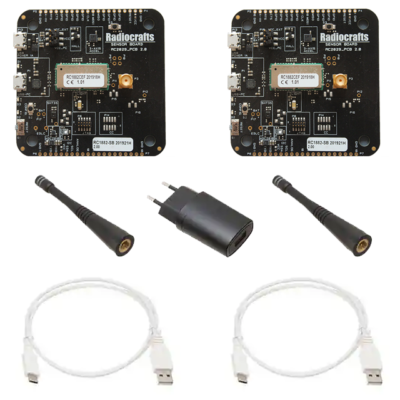
For all our mioty modules, easy-to-use Development Kits are available for rapid prototyping and proof of concept. The kits contain:
- Two Development Boards with MIOTY1 modules
- Breakout of all I/O pins for easy prototyping
- 2 antennas
- 2 USB cables
- FDTI chip for USB to UART interface
Development Kit User Manual
File type: |
File name: |
File description: |
|---|---|---|
|
The Development Kit (DK) is designed to make it easy for the user to evaluate the MIOTY network and to run the modem application with minimal time and effort. This DK User Manual documents the steps to achieve successfully run a MIOTY network. |
Development Kit Reference Design
File type: |
File name: |
File description: |
|---|---|---|
 |
Schematic and PCB documentation used for the development board. This board is recommended to use as a reference design. |
The mioty modules from Radiocrafts contain the modem software and are ready to go as soon as power is connected. The MIOTY1 user manual describes all the AT commands, and also how to use the bootloader and Start testing the AT commands via the UART interface.
Explore Radiocrafts’ vast array of webinars, videos, blogs, and wireless guides to learn more about how you can benefit from using Radiocrafts’ next generation ultra-reliable mioty modules for your next project!
Webinars
File type: |
File name: |
File description: |
|---|---|---|
 |
In this webinar we will answer the most common mioty questions including:
• The benefits and features customers can get out of mioty |
|
|
In this webinar we are joined by Greatech GmbH and Stadtwerke Garbsen GmbH, 2 members of the mioty alliance, to discuss:
• Who are the mioty alliance? |
|
|
In this webinar we will discuss:
• What is mioty? |
|
|
In this webinar we will discuss:
• Approvals with large reach: FCC and CE |
Video Snippets
File type: |
File name: |
File description: |
|---|---|---|
|
mioty was launched by the mioty alliance at Embedded World 2020. Radiocrafts interviewed one of the founding members of mioty, Dr.-Ing. Alexander Kahlig from ifm, and our very own R&D director, Ørjan Nottveit to understand what the mioty alliance is trying to achieve and why mioty is such a game-changing solution. |
Blogs
File type: |
File name: |
File description: |
|---|---|---|
In this blog post we will talk about:
• What truly matters when picking a suitable technology for your application |
||
In this blog post we are going to discuss:
• How the license free bands are getting overcrowded with data packets from an increasing number of IoT devices. |
Free Wireless Guides
File type: |
File name: |
File description: |
|---|---|---|
|
Selecting the right wireless technology is a critical design decision. This technology selection guide will:
• Point out the differences between the technologies to help in selecting the right one |


Radiocrafts’ ultra-reliable and scalable mioty modules have helped our customers get fast to market in a wide variety of wireless applications!

Buy mioty Modules

Buy Online From DigiKey!
Product Name | Frequency | Region Compliance | Buy Module Online | Buy Development Kit Online |
RC1882CEF-MIOTY1 | 866 - 917 MHz | Worldwide* |
Or Contact Radiocrafts Sales Team!